

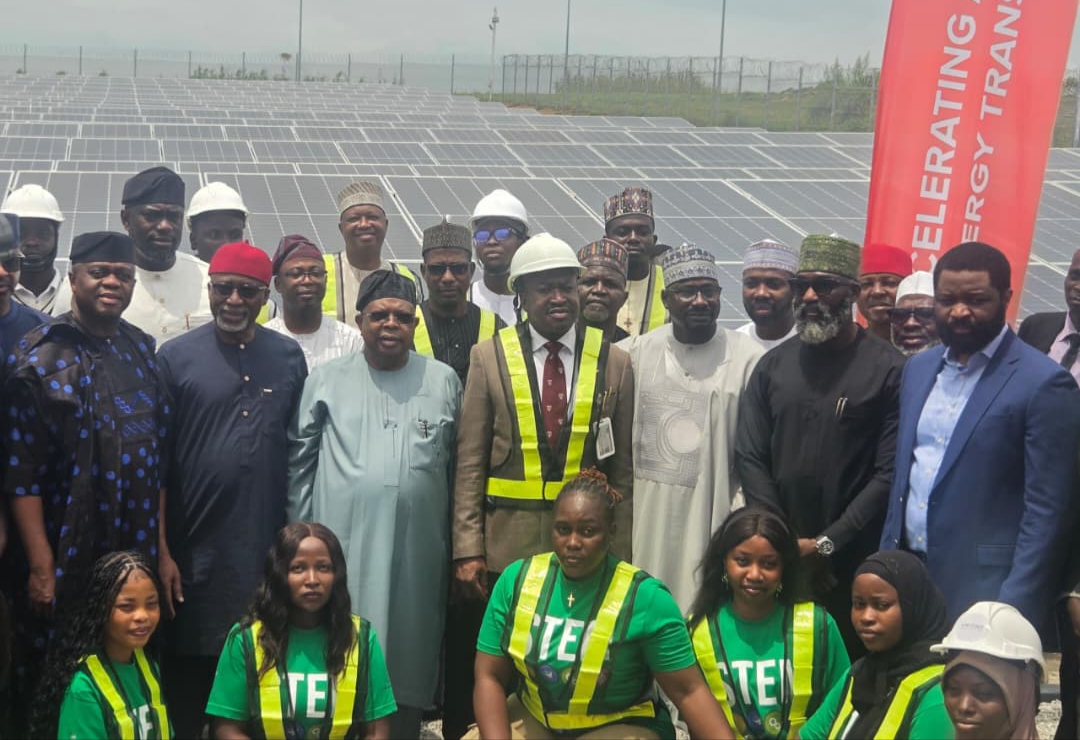
The Federal Government has commissioned a 3MW captive solar hybrid power project at Yakubu Gowon University, Abuja, to strengthen electricity supply for teaching, research, laboratories, digital services and other critical university operations.
The project was delivered under Phase II of the Energizing Education Programme (EEP), implemented by the Rural Electrification Agency (REA) through the World Bank-funded Nigeria Electrification Project (NEP).
Read also: NISO Trains System Operators to Prevent Grid Failures, Boost Power Reliability
With nearly 40,000 students, including more than 8,000 residing on campus, and over 3,500 staff, the university has significant electricity needs across its academic, residential and administrative facilities.
Commissioning the project on Wednesday, Minister of Power, Joseph O. Tegbe, said the investment demonstrated the practical link between Nigeria’s energy transition and human capital development.
“There is perhaps no better place to demonstrate the practical value of Nigeria’s energy transition than a university,” Tegbe said.

He noted that universities require reliable power to support learning, research, healthcare, technology, administration and digital infrastructure.
The minister, however, stressed that the long-term performance of the facility would determine the true value of the investment.
“The commissioning is not the conclusion of the investment. It is the beginning of its most important phase,” he said.
Tegbe linked the sustainability of the project to the recently established Renewable Asset Management Company (RAMCO), which is expected to strengthen the long-term management and performance of renewable energy assets.
Managing Director/CEO of REA, Abba Aliyu, said the Energizing Education Programme had evolved beyond providing electricity infrastructure to demonstrating how reliable energy can support education and human capital development.
According to him, the programme has so far delivered renewable energy infrastructure to 22 federal universities and three affiliated teaching hospitals, deploying more than 100MW of clean energy and impacting over 600,000 students and 50,000 academic and administrative staff nationwide.
Read also: Nigerians Urged to Embrace Religious Tolerance as FG Pledges More Support for Pilgrims’ Welfare

Aliyu said the experience gained from implementing projects at scale had highlighted the importance of planning for the entire lifecycle of energy assets, including construction, commissioning, operation, maintenance and long-term performance.
Head of the Nigeria Electrification Project, Olufemi Akinyelure, said the project should be measured not only by the electricity it generates but also by the development opportunities created through reliable power.
“Government may not be in the business of making profit, but it must always be in the business of making progress,” Akinyelure said.
Vice-Chancellor of Yakubu Gowon University, Professor Hakeem Babatunde Fawehinmi, described the project as an investment in the university’s academic mission.
He said dependable electricity was essential for effective teaching, meaningful research, laboratory operations, digital services and creating a conducive environment for learning and innovation.
Chairman of the Senate Committee on Power, Senator Enyinnaya Abaribe, said the project demonstrated the connection between energy policy, implementation and tangible improvements in the lives of Nigerians.
He called for sustained attention to the operation, maintenance and protection of the facility to ensure that it delivers benefits throughout its useful life.
The project also includes a Renewable Energy Workshop and Training Centre designed to support practical learning and skills development in renewable energy technologies.
The EEP further incorporates a female STEM component, providing students with practical exposure to renewable energy and opportunities within the sector.
Read also: Shettima Takes Nigeria to BRICS Summit, Targets India’s Tech Edge
The Yakubu Gowon University project was delivered through collaboration among the Federal Government, REA, Nigeria Electrification Project, World Bank, the university and EMONE Energy Solutions.
With the facility now commissioned, stakeholders are expected to focus on maintaining its long-term performance and converting improved electricity supply into better learning conditions, stronger research and greater opportunities for innovation.